
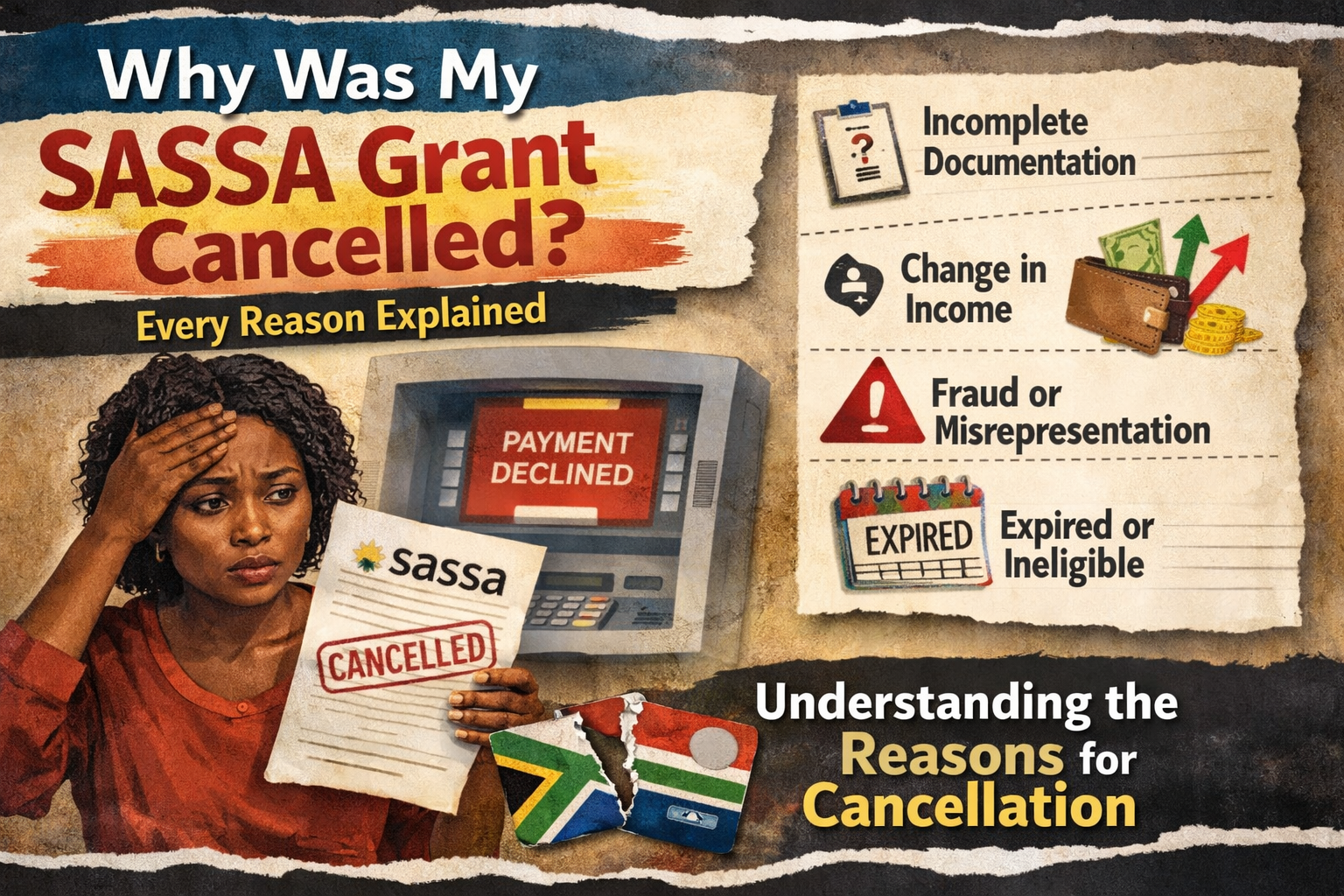
She checked her balance on a Tuesday morning. R0. No SMS. No letter. No warning of any kind.
Thank you for reading this post, don't forget to subscribe!A grandmother in Mitchells Plain had been receiving her Care Dependency Grant for her disabled son for three years without a single issue. Then in early 2026 it simply stopped. Her son’s condition had not changed. Her circumstances had not changed. What had changed was a documentation requirement she had never been told about, buried in a system update most beneficiaries never heard of.
She spent three months trying to understand why before getting a straight answer.
If your SASSA grant was cancelled and nobody has explained why, this guide is for you. Below is every reason a grant gets cancelled in 2026, what each one actually means, and exactly what to do to get your payment restored.
Why This Is Happening More in 2026 Than Ever Before
Before getting into specific reasons, it helps to understand the bigger picture, because what is happening to you is part of a much larger national pattern.
About 70,000 SASSA grants have already been suspended for non-compliance, while nearly 400,000 beneficiaries have been notified that their eligibility is under active review. This is not a once-off audit. It is a structural shift in how South Africa manages its social grant system. National Treasury introduced stricter conditions for SASSA’s budget, including monthly income checks, expanded verification, and regular reporting to Parliament. In plain terms, the government tied SASSA’s funding directly to how well the agency roots out ineligible recipients.
SASSA has intensified data matching with banks, SARS, Home Affairs, NSFAS and the UIF in an effort to detect fraud, duplicate applications and undeclared income. While the process aims to improve the integrity of the system, it has also resulted in legitimate beneficiaries being flagged for reviews, biometric verification, or temporary suspension.
This matters because it tells you something important: a cancellation does not automatically mean you did anything wrong. The system is casting a much wider net than before, and a meaningful number of legitimate beneficiaries are getting caught in it.
The 12 Most Common Reasons a SASSA Grant Gets Cancelled
1. Income Detected Above the Threshold
One of the most common reasons grants are suspended is because SASSA detects possible income that exceeds grant thresholds. The agency regularly cross references beneficiary information with bank deposits, SARS tax records, and UIF claims.
If income above R624 per month is detected, you are declined for that month. This includes any deposits, whether salary, freelance payments, informal income, or even money transferred by family members.
In some cases, beneficiaries say small once-off deposits from relatives or temporary work have triggered investigations. Common false-positive triggers include family transfers, e-wallet cash-ins, refunds, and stokvel payouts. A R700 birthday gift from your sister can technically push you over the threshold for that month in the system’s eyes, even though it has nothing to do with regular income.
What to do: If this happens to you, you have grounds to challenge it. The step-by-step SRD appeal process explains exactly how to submit supporting evidence such as a bank statement or a short affidavit explaining where the deposit came from.
2. NSFAS Registration Detected
SASSA considers NSFAS recipients as already receiving government support, which makes them ineligible for the SRD grant specifically.
If you are showing as NSFAS-registered but are not actually receiving any NSFAS funding, you have options. If you are no longer an NSFAS beneficiary, for example you completed your studies or dropped out, appeal with proof that your NSFAS funding has ended.
3. Already Receiving Another SASSA Grant in Your Name
You cannot receive the SRD R370 grant if you already receive another personal SASSA grant, such as the Disability Grant. This is the single grant rule, and it applies strictly per individual ID number.
Importantly, being a caregiver for a Child Support Grant does not disqualify you. Only receiving a grant in your own name does. If you are flagged incorrectly, for example you are a caregiver and not a personal grant recipient, you can appeal with documentation showing the grant is not in your own name.
4. UIF (Unemployment Insurance Fund) Registration
If you have an active UIF claim or have recently received UIF payments, the system flags this as a conflicting income source. UIF Registered is one of the most frequently disputed status reasons because many people stop receiving UIF payments but the registration itself remains visible in the database long after the payments end.
5. Identity Mismatch With Home Affairs Records
Your ID number, name, or surname on your application does not match the Department of Home Affairs records. This can happen due to a typo, a married name change, or outdated Home Affairs records.
This is one of the more frustrating reasons because it often has nothing to do with your actual eligibility. It is purely a data mismatch issue, and it requires a visit to your nearest SASSA local office with your original ID document to resolve.
6. Banking Details Are Incorrect or Mismatched
Incorrect or mismatched banking information is another major cause of suspended payments. If the bank account linked to your grant is closed, dormant, or registered under a different name than your own, your payment will fail verification.
Keep your banking details and contact number current to avoid payment delays. Outdated details are one of the most common reasons payments are rejected or returned.
7. Failure to Respond to a Review or Reconfirmation Notice
This is becoming one of the leading causes of cancellation in 2026. SASSA has made it clear that people who do not respond to review notifications will face harsh punishments. If a recipient does not show up for a scheduled review or does not send in the required paperwork, their grant payments will stop. If the recipient does not follow the rules for a long time, the grant will be completely cancelled.
Beneficiaries who get notices asking them to verify their information should respond quickly and send in any paperwork that is needed. The warning came at the start of the 2026 fiscal year payment cycle and applies across all grant types, not just the SRD.
8. Self-Cancellation (You Cancelled It Yourself or a Family Member Did)
If your circumstances changed and you no longer qualified for a grant, you or someone on your behalf may have formally cancelled it. Once SASSA processes the cancellation, payments stop from the next payment cycle. If you cancel partway through a month, that month’s payment may still be made because grants are paid in advance.
If this was done in error or without your knowledge, you need to visit your nearest SASSA local office immediately with your ID document to dispute the cancellation.
9. The Beneficiary Has Passed Away (False Death Match)
SASSA cross-references beneficiary records against Home Affairs death registrations to stop paying grants to deceased individuals. Occasionally, a data error incorrectly links a living beneficiary’s ID to a death record, often due to a similar ID number or a relative sharing a similar name. This is rare but devastating when it happens, and it requires an urgent visit to a SASSA office with your ID document and, if necessary, a sworn affidavit confirming you are alive.
10. Disability Grant Medical Reassessment Lapsed
For Disability Grant recipients, medical reassessments are required periodically. SASSA may call beneficiaries for a review if their temporary disability period expires. If you do not attend the scheduled medical review or your temporary disability certificate expires without renewal, your grant will be cancelled automatically.
What to do: Contact your nearest SASSA office immediately to schedule a new medical assessment. Bring any updated medical documentation from your doctor.
11. Care Dependency Grant Documentation Requirements Changed
Caregivers of children with severe disabilities receiving the Care Dependency Grant have reported cancellations tied to new documentation requirements introduced without clear public notice. If your child’s condition has not changed but your grant was cancelled, this is worth investigating specifically, as it may relate to an updated medical assessment form or a renewed proof-of-care requirement rather than any actual change in eligibility.
12. Duplicate Application or Suspected Fraud Flag
If the system detects what appears to be a duplicate application, either someone applying twice under slightly different details, or fraudulent use of your ID by someone else, your grant can be suspended pending investigation. This requires you to visit a SASSA office in person with your ID document to prove your identity and resolve the duplicate flag.
How to Check Exactly Why Your Grant Was Cancelled
Before doing anything else, find out the specific reason listed against your account. This single step saves enormous amounts of wasted time.
For SRD R370 beneficiaries, check your SASSA SRD status online using your South African ID number and registered phone number. The status page will display a specific reason code or description, not just a generic “declined” or “cancelled” message.
If you are unsure what your specific status result means, the complete guide to all SASSA SRD status meanings explains every possible result and the action required for each one.
For permanent grants (Older Person’s, Disability, Child Support, Care Dependency, Foster Child), call the SASSA toll-free helpline on 0800 60 10 11. This is free from any network. Have your ID number ready. The call centre agent can tell you the specific reason logged against your file.
Step-by-Step: What to Do After Your Grant Is Cancelled
Step 1: Identify the exact reason. Use the status check tools above or call 0800 60 10 11. Do not skip this step. Acting without knowing the specific reason wastes time and often leads to the wrong corrective action.
Step 2: Gather supporting evidence specific to your reason. If the reason was income-related, gather bank statements covering the flagged period and, if relevant, a written explanation or affidavit about any unusual deposits. If the reason was identity mismatch, gather your original ID document and any documents showing a name change such as a marriage certificate. If the reason was NSFAS or UIF related, get a letter from the relevant institution confirming your current status.
Step 3: Decide between reconfirmation, reapplication, or appeal. These are three different processes that apply to different situations. If SASSA is simply asking you to verify your existing details, that is reconfirmation. If your application was formally closed and you need to start a new review cycle, that is reapplication. If you believe a specific decision was wrong and want it reconsidered, that is an appeal.
Step 4: Submit through the correct official channel. For SRD matters, this is the portal at srd.sassa.gov.za. For permanent grants, this is your nearest SASSA local office. Never use unofficial websites or pay anyone to “fast-track” your case. SASSA allows reapplication, reconfirmation, and appeals only through its official channels. No agent or payment is required.
Step 5: Follow up within the expected timeframe. Reconsideration is typically handled within 60 to 90 days by the Independent Tribunal for Social Assistance Appeals (ITSAA), which operates separately from SASSA. If ITSAA rules in your favour, SASSA is required to repay the grant for all affected months.
How Long Does It Take to Reinstate a Cancelled Grant?
This depends entirely on the reason and the resolution path.
A simple data correction, such as fixing a banking detail mismatch or correcting an ID number typo, can often be resolved within one to two payment cycles once you have visited a SASSA office with the correct documentation.
A formal appeal through the Independent Tribunal typically issues a decision within 60 to 90 days and notifies you by SMS. If the Tribunal rules in your favour, SASSA must reinstate your grant and pay arrears within 30 days.
A medical reassessment for the Disability Grant or Care Dependency Grant depends on the availability of an assessment appointment, which can vary by province and can take anywhere from a few weeks to a couple of months.
Can a Cancelled Grant Be Backdated and Repaid?
In many cases, yes, but it is not automatic.
If the Tribunal rules in your favour, SASSA is required to repay the grant for all affected months. This means if your grant was wrongly cancelled for three months and your appeal succeeds, you should receive payment for all three of those months, not just going forward.
For reapplications rather than appeals, backdating is handled at SASSA’s discretion and is not guaranteed in the same way. If you believe you were eligible during a suspended period and your reapplication is approved, raise the backdating question specifically with the SASSA officer handling your case.
Organisations That Can Help You for Free
If you are struggling to navigate a cancellation, especially one involving a formal appeal, you do not have to do it alone.
Organisations like Black Sash and Legal Aid South Africa offer free assistance with appeals. These organisations specialise in social grant disputes and have experience helping beneficiaries prepare the right documentation and navigate the Independent Tribunal process. There is no cost for this assistance.
How to Prevent Future Cancellations
Once your grant is reinstated, a few simple habits significantly reduce your risk of running into the same problem again.
Keep your banking details and registered phone number current at all times. If you switch banks or change your number, update SASSA immediately rather than waiting for a problem to surface.
Respond to every SMS or notification from SASSA promptly, even if you are not sure what it means. A delayed response to a reconfirmation request is one of the fastest paths to an avoidable cancellation.
If you receive an unexpected deposit, particularly one that might push your monthly income above the R624 threshold for SRD purposes, keep a record of where it came from in case you need to explain it later.
Attend any scheduled medical reassessment for Disability or Care Dependency Grants on the date given. Missing these appointments without rescheduling is one of the most preventable causes of cancellation.
Frequently Asked Questions
Why was my SASSA grant cancelled without any warning?
SASSA is required to notify beneficiaries of reviews and reconfirmation requests, but in practice many beneficiaries report not receiving an SMS or receiving one that went unnoticed. If you were not warned, check your status immediately using the helpline or online portal to identify the specific reason, then address it directly rather than assuming the worst.
Can my grant be cancelled because of a single large bank deposit?
Yes. SASSA checks bank accounts and SARS records every month for the SRD grant specifically. A single deposit above R624 in the assessed month, even a once-off gift or refund, can trigger a decline or flag for that month. This is appealable with documentation explaining the source of the deposit.
My grant shows as cancelled but I never cancelled it myself. What happened?
This could be due to a missed reconfirmation deadline, a data mismatch with Home Affairs, a false fraud flag, or in rare cases an incorrect death match. Visit your nearest SASSA local office with your ID document to investigate the specific cause.
How do I know if I should reapply or appeal?
Reapply if your application was formally closed and you need a fresh review. Appeal if you believe a specific decision or month’s decline was incorrect and you want it reconsidered. The two processes are different and use different channels.
Will I get back-paid for the months my grant was wrongly cancelled?
If your appeal is successful through the Independent Tribunal, SASSA is required to repay the grant for all affected months within 30 days of the ruling. Reapplication-based reinstatements are not guaranteed to be backdated and depend on SASSA’s discretion.
Is there a free way to get help with my appeal?
Yes. Black Sash and Legal Aid South Africa both offer free assistance with SASSA grant appeals and have experience handling these specific disputes.
The Bottom Line
A SASSA grant cancellation in 2026 is rarely arbitrary, but it is also not always correct. The system is running far more aggressive cross-checks than it used to, which means more legitimate beneficiaries are getting caught alongside genuinely ineligible ones.
The first step is always the same: find out the exact reason. Use the official SASSA status check for SRD grants, or call 0800 60 10 11 for permanent grants. Once you know the specific reason, the path to resolution becomes much clearer, whether that means a quick data correction at a local office or a formal appeal through the Independent Tribunal.
Do not assume a cancellation means you did something wrong. Do not ignore the notification either. Act on it, gather your evidence, and use the official channels. Most cancellations, even the frustrating ones, are resolvable.
Has your SASSA grant been cancelled recently? Share what reason you were given and how you resolved it in the comments below. Your experience might be exactly what someone else needs to read today.