
MySRD Checker
MySRD Checker
The SASSA SRD R370 grant is designed to support unemployed individuals and families facing financial difficulties. It helps beneficiaries stay informed about their grant status and payment dates while offering access to useful support services.
Along with the SRD status updates, users can explore resources such as financial literacy programs, unemployment guidance, vocational and skills training, and smart budgeting tools. These services aim to improve long-term financial stability and independence.
The South African Social Security Agency (SASSA) provides the Social Relief of Distress (SRD) R370 grant to eligible South African citizens, asylum seekers, and permit holders. This monthly assistance helps cover basic needs including food, education costs, medical expenses, and essential household requirements.
Seeing “approved” when you check your SASSA status is great news, but many people aren’t sure what comes next. This guide explains exactly what approved status means, when you’ll get paid, and what to do if there are delays.
When your status shows approval, it means SASSA has checked your information and confirmed you qualify for the R370 SRD grant. They’ve verified your details with government databases like SARS, UIF, and Home Affairs, and everything checked out.
Approved means you passed all the requirements: you’re between 18-60 years old, unemployed, South African or a permanent resident, and not receiving other government support. Your application is now moving to the payment stage.
Important to know: Approved doesn’t always mean immediate payment. There are still a few steps before money reaches your account or collection point.
Once approved, SASSA adds you to their payment system. They’ll process your payment according to their monthly schedule. Most payments go out in the first week of each month.
You need to have your payment method set up correctly. This could be:
SASSA will send you an SMS when your payment date is confirmed. You’ll get another SMS when the money is actually sent.
Keep in mind: SASSA checks your details every month. If something changes (like you get a job or start receiving other support), your approved status can decline.
For first-time approvals: Payment usually takes 5-10 working days if your banking details are correct. Sometimes it takes a bit longer (15-20 days) while SASSA sets up your payment profile.
For regular monthly payments: If you’ve been approved before and received payment already, your next payment should come in the first week of the month.
If you were approved mid-month: You’ll likely get your first payment in the next month’s payment cycle, not immediately.
Payment methods matter:
This is common for new approvals. SASSA has approved your eligibility but hasn’t assigned you to a payment batch yet. This usually sorts itself out within 10-15 working days.
What to do: Check your status every 3-4 days. Once a payment date appears, you’ll know exactly when to expect money.
If no payment date shows after three weeks, your banking details might need verification. Visit a SASSA office with your ID, bank card, and proof of residence.
If you’ve been approved for 2-3 months with no payment, something is definitely wrong. Usually it’s one of these issues:
Banking problems:
What to do: Call SASSA at 0800 60 10 11 or visit an office. Bring your ID and current bank statements. You may need to update your payment details.
SASSA can’t pay you if your banking information doesn’t work. The money gets sent back, and you stay in “approved but not paid” status until it’s fixed.
Even small mistakes stop payments completely:
How to fix it:
After updating, wait 7-10 working days for verification. Make sure the bank account you provide is active and belongs to you.
This happens when SASSA’s monthly checks find new information suggesting you no longer qualify. Common reasons:
Check your decline when you look at your status it tells you exactly what triggered the change.
If the decline is wrong (like you’re not actually working), you can appeal within 90 days. You’ll need proof like:
Look at the information shown when you check your status. Make sure your:
Check every 5-7 days using:
This helps you catch any problems early.
SASSA sends important updates via SMS to your registered number. If you change numbers, update this immediately on the SASSA website or at an office.
Starting work, registering for studies, or applying for other grants can change your approved status to decline.
For general questions:
For payment problems: Visit a SASSA office with:
Offices open 8 AM – 4 PM, Monday to Friday. Arrive early to avoid long queues.
For quick checks:
Warning: Never pay anyone who claims they can “speed up” your payment. All SASSA services are free.
If your application shows declined, read our complete SRD appeal process guide to understand how to submit your reconsideration correctly.
Seeing “pending” can be frustrating when you need money urgently. This guide explains what pending means, how long it usually lasts, and when you should take action.
Pending means SASSA is still checking your information. They haven’t approved or declined you yet your application is still being reviewed.
SASSA checks several government databases:
These checks are automatic, but they take time. Pending doesn’t mean you’re rejected, it just means the process isn’t finished.
Normal waiting time: 14-30 days from when you applied
During busy periods: 45-60 days (like when new payment cycles start)
First-time applicants: Usually wait longer than people reapplying
Red flag timing: If you’ve been pending for more than 60 days, something might be wrong. After 90 days, you should visit a SASSA office.
Don’t panic be patient
Checking your status 10 times a day won’t speed things up. Check once every 7-10 days instead.
Keep your phone active
SASSA might SMS you if they need documents or information. Make sure your registered number can receive messages.
Don’t make changes
While pending, don’t update your details or submit multiple applications. This can actually slow things down.
Gather documents
Start collecting things you might need later:
Database delays
Government systems sometimes take weeks to respond to SASSA’s queries. There’s nothing you can do except wait.
Mismatched information
If your application details don’t match what’s in government databases, your case needs manual review. This takes much longer.
Common name problems
If you have a very common name, SASSA’s system needs extra time to make sure they’re checking the right person.
Peak period backlogs
Applications during busy times join longer queues. The first week of the month and month-end are the worst.
This usually means there’s a verification issue that needs attention.
What to do: Visit a SASSA office with:
Staff can check what’s holding up your application and sometimes speed up the resolution.
If your status changed from approved/declined to pending, SASSA is re-checking your eligibility. This happens when:
This type of pending usually clears faster within 10-15 days.
Updating banking information or personal details can send your status back to pending while SASSA verifies the changes.
Normal verification time: 7-14 days
What not to do: Don’t make more updates while one is being processed. This creates confusion and more delays.
For basic questions:
If pending for 60+ days:
Best times to visit/call:
Remember: Avoid paying people who say they can “speed up” your application process.
Being declined is disappointing, but understanding why helps you decide what to do next. Many declined applications can be successfully appealed if the reason was wrong.
Declined means SASSA checked your information and decided you don’t qualify for the R370 grant right now.
When you check your status, it shows the specific reason you were declined. Understanding this reason is crucial for deciding whether to appeal or reapply.
Common decline reasons:
This is the most common reason. SARS or UIF databases show you as employed, even if:
If you’re genuinely unemployed: You can appeal with proof like:
If you’re registered with NSFAS, you can’t get SRD even if:
The registration alone triggers the decline.
To appeal: Get an official letter from NSFAS showing:
You can’t receive SRD if you’re getting another SASSA grant (disability, pension, child support, foster care).
Sometimes this decline happens by mistake when:
To fix it: Provide proof you’re not receiving any grants:
Declines happen when:
Solution: Make sure your bank account:
Yes, but…
Only reapply if something has genuinely changed. Simply applying again without fixing the problem will result in another decline.
Good reasons to reapply:
Bad idea to reapply:
Better option: Appeal instead of reapplying, especially if the decline was wrong.
You have 90 days from the decline date to appeal. Appeals are completely free.
Option 1 – Online:
Option 2 – WhatsApp:
Option 3 – SASSA Office:
Bring documents that prove the decline reason is wrong:
For employment declines:
For NSFAS declines:
For other grant declines:
Processing time: 30-60 days (sometimes up to 90 days)
SASSA’s appeal team will:
Possible outcomes:
Check your status weekly to see when it updates.
Ask for a written explanation: Request details about why your appeal failed.
Get help: Contact organizations that assist with SASSA issues:
Request a review: You can ask SASSA’s regional office to review the appeal decision.
Be honest with yourself: If you’re genuinely employed or receiving other support, more appeals won’t help. The system is checking factual database records.
For basic information:
For appeal help:
For complex situations:
Remember: All SASSA services are FREE. Don’t pay anyone to “fix” your decline.
If your application shows declined, read our complete SRD appeal process guide to understand how to submit your reconsideration correctly.
EKYC stands for “Electronic Know Your Customer.” It’s a security check SASSA uses to make sure you are who you say you are.
EKYC is a biometric verification process. SASSA uses it to confirm your identity and prevent fraud.
What they check:
You might need EKYC if:
Important: You can’t get paid until you complete EKYC, even if you’re approved.
Option 1 – SASSA Office:
Option 2 – Mobile EKYC Units:
Option 3 – Partner Locations:
What to bring:
The process:
Time it takes: 10-20 minutes (plus waiting time)
Step 1: Your biometric data uploads (24-48 hours)
Step 2: SASSA verifies it against Home Affairs (3-7 days)
Step 3: Your status updates (1-3 days after verification)
Total time: Usually 5-14 working days
Once verified:
This happens when:
Solutions:
If verification fails repeatedly:
What to do:
If your status hasn’t updated after 14 days:
Fix it:
At the EKYC station: 10-20 minutes
Complete process (until status updates): 5-14 working days
During busy times: Up to 21 days
Red flag: If it’s been more than 30 days since EKYC, visit a SASSA office. There’s likely a technical problem.
To find where to do it:
For technical problems:
Don’t bother calling about:
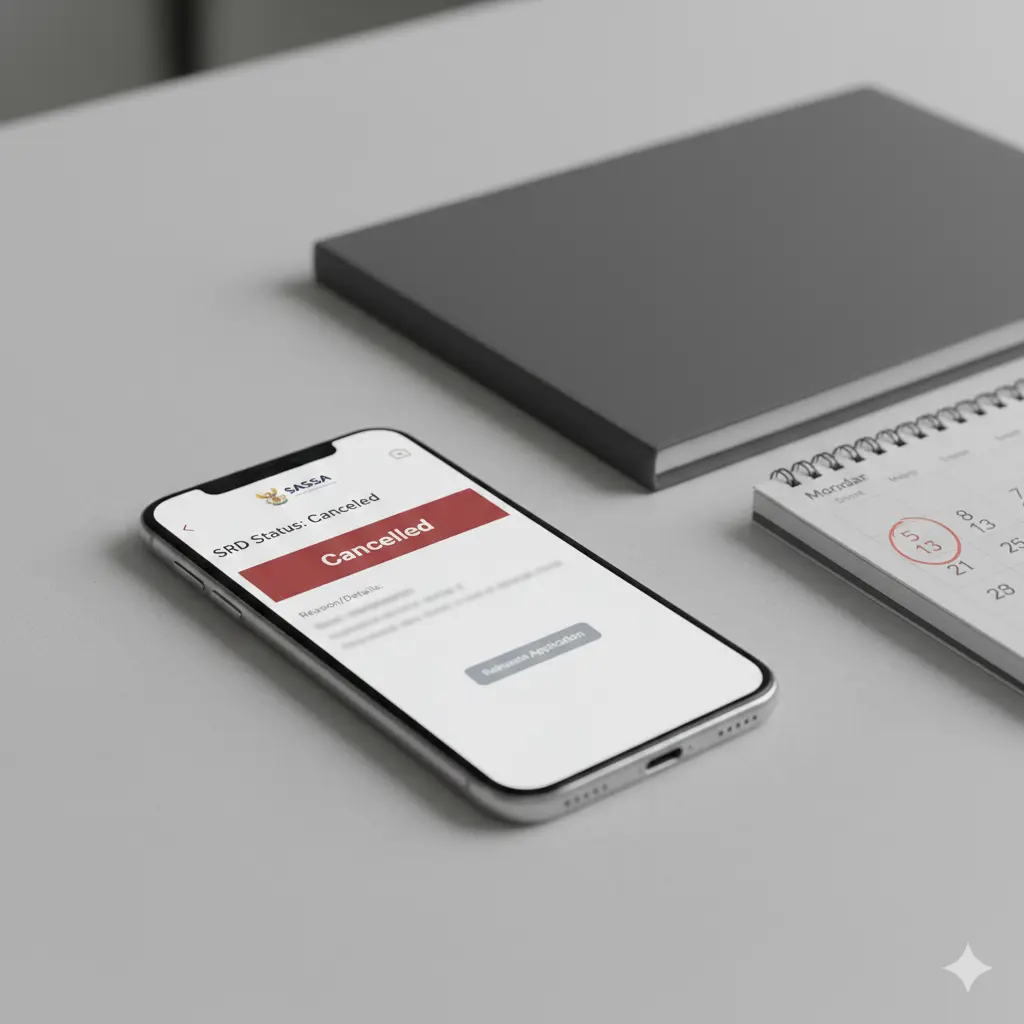
“Cancelled” means your grant was stopped. This is different from “declined” cancellations to grants that were active but are now terminated.
Your SRD grant was approved and maybe even paid, but SASSA has now stopped it.
This happens when SASSA’s monthly checks find:
Important: Cancelled doesn’t mean you did something wrong. Sometimes databases have errors or outdated information.
Even part-time, temporary, or casual work can trigger cancellation if:
If the job already ended:
If you’re still working:
If you registered for the new academic year, your grant cancels automatically even if:
To appeal:
Your SRD cancels if:
If it’s wrong:
Sometimes grants cancel because Home Affairs records incorrectly show you as deceased.
Immediate action:
Yes, if:
How:
You have 90 days from cancellation to appeal.
Online:
WhatsApp:
SASSA Office:
For employment cancellations:
For NSFAS cancellations:
For other grant cancellations:
For death record errors:
Wait time: 30-60 days (up to 90 days for complex cases)
SASSA will:
Outcomes:
Appeal if:
Reapply if:
Both if:
Neither if:
If your verification is failing due to an old number, update it using our complete SASSA SRD mobile number correction guide.
Quick checks:
For appeals:
For complex issues:
Office hours: 8 AM – 4 PM, Monday-Friday
Remember: SASSA never charges for appeals or reinstatement. Don’t pay anyone claiming they can help.
For first-time approved applicants, payment usually takes 5-10 working days if your banking details are correct. However, it can take up to 15-20 days while SASSA sets up your payment profile in their system. If you’ve been approved before and are receiving regular monthly payments, your next payment should arrive during the first week of the month. The exact timing also depends on your payment method: bank accounts receive funds within 3-5 days after SASSA releases payment, while mobile wallets and retail collection points may take 5-8 working days.
Yes, your approved status can change to declined if SASSA’s ongoing monthly verification checks find new information suggesting you no longer qualify. This commonly happens when you get a job (even temporary or part-time work), register for NSFAS funding, start receiving another SASSA grant, or when government databases show you’re receiving income. SASSA runs these verification checks every month throughout the year. If your status changes from approved to declined, check the decline reason shown on your status and consider appealing within 90 days if you believe the information is incorrect.
Being approved for this long without payment indicates a problem with your banking or collection details. Your bank account may be closed, your account number might be incorrect (even one wrong digit stops payment), your mobile wallet could be deregistered, or your details don’t match your ID exactly. Contact SASSA immediately by calling 0800 60 10 11 or visiting a SASSA office with your ID document and current bank statements. You’ll likely need to update or verify your payment method details. Once corrected, verification takes 7-10 working days before payment processes.
Being approved for this long without payment indicates a problem with your banking or collection details. Your bank account may be closed, your account number might be incorrect (even one wrong digit stops payment), your mobile wallet could be deregistered, or your details don’t match your ID exactly. Contact SASSA immediately by calling 0800 60 10 11 or visiting a SASSA office with your ID document and current bank statements. You’ll likely need to update or verify your payment method details. Once corrected, verification takes 7-10 working days before payment processes.
Most applications in pending status receive a final decision within 14-30 days from the application date. During busy periods (like when new payment cycles open or after SASSA announcements), pending can extend to 45-60 days. If your status has been pending for more than 60 days, this suggests a verification problem requiring attention. After 90 days in pending without any change, you should definitely visit a SASSA office to investigate what’s causing the delay. Check your status once every 7-10 days while waiting, checking more frequently won’t speed up the process.
No, you will not receive any payment while your status shows pending. Pending means SASSA hasn’t made a final decision on your eligibility yet they’re still conducting verification checks against government databases. Payment only begins after your status changes to approved. If your status eventually changes to approved, you’ll receive payment according to SASSA’s monthly payment schedule (typically the first week of the month), but you won’t receive backdated payments for the months you spent in pending status unless you were incorrectly declined and successfully appealed.
No, don’t submit a new application while your current one is pending. Creating duplicate applications causes confusion in SASSA’s system and can actually slow down processing further. Instead, if you’ve been pending for more than 60 days, visit a SASSA office with your ID document, bank statements showing no income, and any proof of unemployment. The consultant can check your application notes to see exactly what’s causing the delay and sometimes expedite resolution of verification issues. Only reapply if your application was formally declined and you’ve decided not to appeal, or if you withdrew your original application.
You can reapply immediately, but it’s usually better to appeal first if you believe the reason for the decline is incorrect. Simply reapplying without addressing the decline reason will likely result in another decline because SASSA checks the same government databases. Appeal if the decline was based on wrong information (like employment records showing you’re working when you’re not) because successful appeals can result in backdated payments for the months you were incorrectly declined. Only reapply if the decline reason was valid but your circumstances have genuinely changed—for example, your job officially ended and databases have updated (wait 30-45 days after job loss), or your NSFAS funding was cancelled.
You have 90 days from the decline date to submit an appeal. This is a strict deadline, so don’t delay if you plan to appeal. Appeals can be submitted online through the SASSA SRD website (srd.sassa.gov.za), via WhatsApp (082 046 8553), or by visiting a SASSA office in person. Make sure you have supporting documents ready that prove the decline reason is incorrect—for employment declines, this includes employer letters confirming job termination, bank statements showing no salary deposits for 3-6 months, and your last payslip. After 90 days, you lose the right to appeal and would need to submit a fresh application instead.
If your appeal is unsuccessful, you’ll receive an SMS explaining why the appeal was rejected. At this point, you can request a written explanation from SASSA detailing the decision and what evidence it was based on. You have the option to request a review of the appeal decision through SASSA’s regional office, though this process can take several months. If you genuinely believe the decline is wrong despite the failed appeal, consider seeking help from organizations like Black Sash, legal aid clinics, or community advice offices that specialize in SASSA grant issues. However, if government databases correctly show you’re employed or receiving other support, additional appeals won’t change the outcome—the system is checking factual records.
If your fingerprints won’t scan, this is usually because of very dry skin, damaged fingerprints from manual labor, or technical issues with the scanner. Try moisturizing your hands well before your EKYC appointment and avoid doing manual work for a day or two beforehand if possible. The consultant may try scanning different fingers to find ones that work better. If all your fingerprints consistently fail to scan due to damage or wear, SASSA can complete EKYC using facial recognition alone you must specifically request this option at the EKYC station. If problems persist, visit a SASSA office (rather than a partner location) where they can escalate your case for manual verification.