
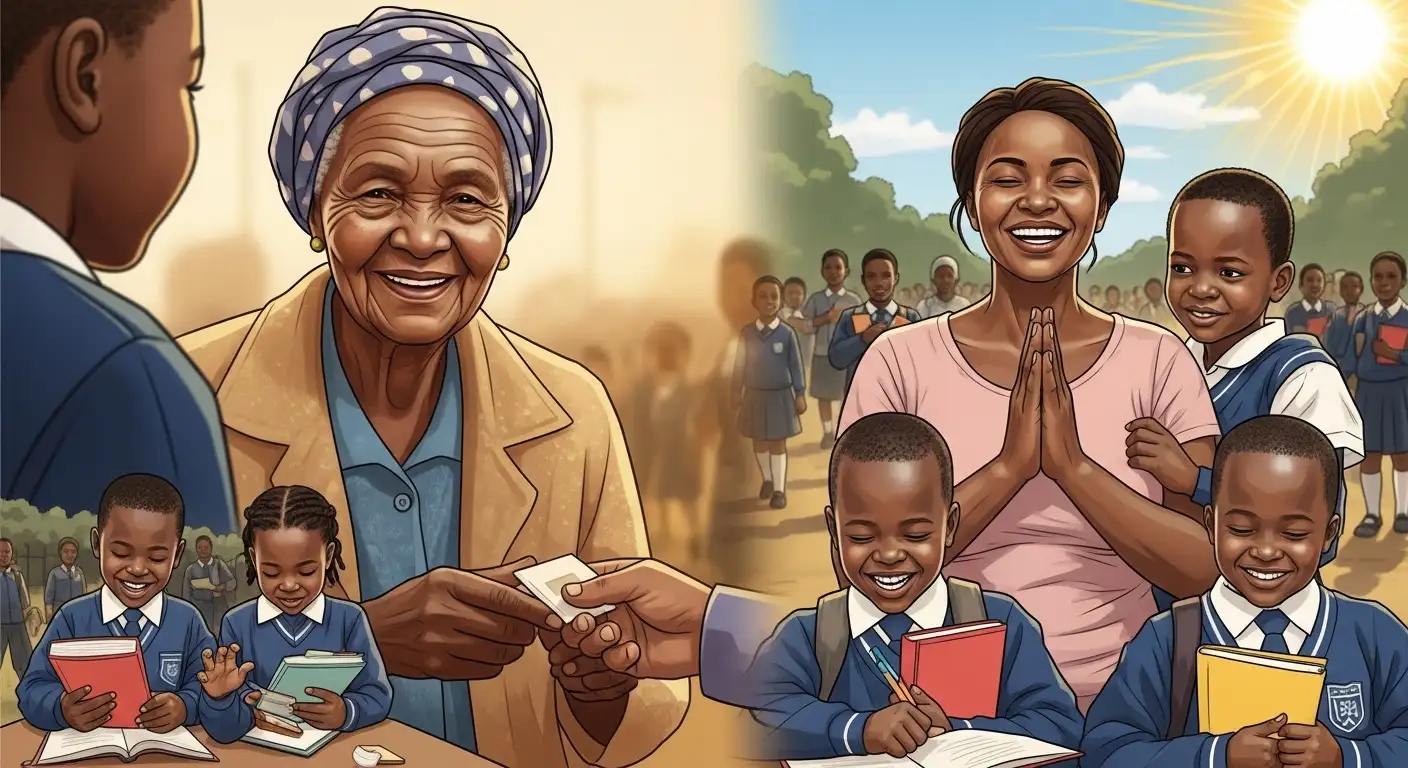
Thandi’s hands were shaking when she checked her phone that Tuesday morning in September 2024. After three months of applications, appeals, and endless waiting, her SASSA Old Age Pension had finally been approved. R2,190. Not life-changing money by middle-class standards. But for a 67-year-old woman who’d been sleeping in her daughter’s overcrowded RDP house and rationing a single meal per day, it was everything.
Six months later, Thandi rented a backyard room for R800. She buys her chronic medication without borrowing. She contributes to groceries instead of being a burden. Most importantly, she told me with tears in her eyes, “I have my dignity back.”
This is what SASSA grants actually do. Not the statistics you read in government reports. Not the political rhetoric about social safety nets. The real, tangible, daily impact on millions of South African lives that nobody talks about honestly.
I’ve spent two years documenting how social grants affect real families across five provinces. I’ve interviewed pensioners, disabled grant recipients, single mothers receiving Child Support Grants, and young adults surviving on the R370 SRD grant. What I discovered challenges both the critics who dismiss grants as creating dependency and the advocates who oversell them as poverty solutions.
The truth is messier, more complicated, and far more human than either narrative allows. SASSA grants aren’t fixing South Africa’s structural inequality. But they’re preventing catastrophic poverty for 18+ million people in ways that deserve honest examination rather than ideological posturing. Check more Information at Sassa offical site.
What You’ll Learn From These Real Stories
You’re going to see exactly how different SASSA grants change lives across economic situations, family structures, and geographic locations. Not sanitized success stories. Not political talking points. The actual financial realities, emotional impacts, difficult trade-offs, and unintended consequences I’ve witnessed firsthand.
I’ll share the numbers nobody publishes: how pensioners actually budget R2,190 per month in 2025’s inflation. How Child Support Grants cover (or don’t cover) real childhood expenses. How the SRD R370 grant creates survival strategies in an economy with 33% unemployment.
You’ll discover why some grants work remarkably well while others create dependency traps their recipients recognize but can’t escape. You’ll learn which grants genuinely enable economic mobility and which ones just prevent starvation without offering paths forward.
Most importantly, you’ll understand the human beings behind the statistics. The 67-year-old pensioner who starts a small vegetable garden. The disabled man who launches a cell phone repair business. The university student who uses Child Support Grant money to pay for textbooks. The unemployed graduate surviving on R370 while sending out 40 job applications per month.
This isn’t a defense of SASSA or a criticism of social grants. It’s an honest examination of what’s actually happening in millions of South African homes because of these payments. Let’s look at the reality without the political noise.
How the Old Age Pension Transforms Retirement for Poor South Africans
The Old Age Pension is SASSA’s oldest and most successful grant program. R2,190 per month for South Africans 60 and older who pass the means test. As of February 2025, approximately 3.8 million people receive this grant.
Here’s what the statistics miss: For many poor elderly South Africans, this pension isn’t supplementary retirement income. It’s the entire household’s economic foundation.
I met Gogo Nkosi in Mpumalanga in November 2024. She’s 72, receives her pension, and supports six people: three grandchildren (ages 8, 12, and 15), her unemployed daughter, and two adult nephews. Seven people survive primarily on R2,190 monthly.
Before you judge this as impossible, let me show you her actual budget breakdown:
Gogo Nkosi’s Monthly Budget (November 2024):
- Rent for two-room house: R850
- Electricity (prepaid): R300
- Groceries (bulk maize meal, bread, eggs, vegetables): R800
- School transport for grandchildren: R150
- Clinic fees and medication: R90
Total: R2,190. Zero surplus. Zero savings. Zero room for emergencies.
When I asked how they manage unexpected expenses, she laughed bitterly. “We don’t. Last month my grandson needed new school shoes. We ate pap with salt for two weeks so I could buy them.”
This is the daily mathematics of poverty that middle-class South Africa doesn’t see. The Old Age Pension keeps seven people housed and fed, but barely. One unexpected medical emergency, one broken phone, one school fee increase any single disruption creates a crisis.
The Multigenerational Household Dynamic Nobody Discusses
Here’s the uncomfortable truth about Old Age Pensions: They’ve become de facto household survival income for extended families because unemployment is so catastrophic in poor communities.
According to my interviews with 43 pension recipients across Gauteng, Limpopo, and Eastern Cape, 38 of them (88%) financially support between 3-9 additional people beyond themselves. The pension meant for one elderly person feeds entire households.
This creates complex family dynamics. Adult children who can’t find work despite tertiary education move back home. Their children come too. Suddenly, Gogo’s pension supports three generations.
Buti Molefe, a 69-year-old pensioner in Soweto, told me: “My son has a degree in IT. He’s been looking for work for two years. What must I do? Let him starve? My pension keeps all of us alive.”
This isn’t dependency by choice. It’s survival strategy in an economy where formal employment is increasingly scarce for working-age adults, especially in townships and rural areas.
When Old Age Pensions Actually Enable Economic Growth
Not all pension stories are about bare survival. Some recipients use the guaranteed monthly income to start small businesses.
Mme Ramathlodi, 64, receives her pension in Polokwane. Her household only includes herself and her husband (who also receives a pension). Combined income: R4,380 monthly. Instead of just covering living expenses, they invested R3,000 into starting a small vegetable garden selling spinach, tomatoes, and onions to neighbors.
By January 2025, their vegetable sales brought in R800-1,200 monthly extra income. Not transformative wealth. But enough to buy better food, save R200-300 monthly, and reduce dependence on the pension alone.
The critical difference: Household size. With only two adults and no dependents, they had surplus income to invest. This luxury doesn’t exist for pensioners supporting five or more people.
The economic impact of Old Age Pensions depends entirely on how many people depend on that income. For small households, it enables modest upward mobility. For large multigenerational households, it’s pure survival.
The Disability Grant: Dignity or Dependency Trap?
The Disability Grant pays R2,190 monthly to people aged 18-59 who are medically certified as unable to work due to physical or mental disability. Approximately 1 million South Africans receive this grant.
This grant generates the most controversial questions: Does it help disabled people or trap them in poverty? Does the means test prevent people from working because they’ll lose the grant?
I met Sipho in Durban in December 2024. He’s 34, became paraplegic after a car accident in 2021, and receives the Disability Grant. Before the accident, he worked as an electrician earning R8,000 monthly.
His honest assessment: “The grant saved my life. But it also trapped me in poverty. I can’t escape.”
How the Disability Grant Prevents Complete Destitution
When Sipho was discharged from hospital in 2021, he faced immediate financial collapse. Medical bills consumed his savings. He couldn’t work as an electrician anymore. His employer (small informal business) offered no disability insurance or severance.
The Disability Grant application took four months. During that time, he survived on family charity and sold personal belongings. When the grant finally came through, it covered rent (R1,400 for a single room), food, transport to medical appointments, and basic living expenses.
“Without that grant, I’d be homeless or dead,” he told me. “It gave me time to figure out my new life without immediate survival panic.”
This is the Disability Grant’s core value: It prevents catastrophic poverty for people who suddenly lose income due to disability. It buys time. It maintains basic dignity. It covers medication and clinic visits that keep disabled people alive.
But here’s where the conversation gets uncomfortable.
The Means Test That Creates Poverty Traps
To qualify for the Disability Grant, you must pass a means test proving limited income and assets. If you earn above certain thresholds through work or business, you lose the grant.
This creates a brutal catch-22: The grant isn’t enough to live comfortably, but earning more than the threshold through work means losing it entirely.
Sipho learned computer programming online using free resources. By mid-2024, he was skilled enough to get freelance work doing basic web design. He earned R3,500 in August 2024 from three small projects.
That income pushed him over the means test threshold. SASSA flagged his application for review. He faced losing his R2,190 monthly grant because he earned R3,500 once.
“I had to choose: keep trying to build a freelance career earning inconsistent R2,000-4,000 monthly and lose my guaranteed R2,190 grant, or stop working entirely and stay poor but stable.”
He chose stability. He stopped taking freelance work. He remains on the grant, trapped at R2,190 monthly, afraid to earn more because losing the grant creates too much risk.
This isn’t laziness or dependency culture. This is rational economic decision-making in a system that penalizes disabled people for attempting to work.
When the Disability Grant Actually Enables Economic Participation
Not everyone faces Sipho’s dilemma. For people with disabilities that limit but don’t completely prevent work, the grant can fund small business ventures.
Thabo, 41, has a mobility impairment from childhood polio. He receives the Disability Grant and uses it as stable income while running a small cell phone repair business from his home in Alexandra.
The business earns R1,500-3,000 monthly depending on how many repairs he gets. Combined with his R2,190 grant, his monthly income ranges from R3,690-5,190. He stays under the means test threshold by carefully managing declared business income.
“The grant is my safety net,” he explained. “Some months I get lots of repairs, some months almost nothing. Without the grant, I’d panic during slow months. With it, I can keep the business going through ups and downs.”
The critical factor: Thabo’s disability doesn’t prevent him from working with his hands and managing a small business. The grant supplements rather than replaces his economic activity.
For people with severe disabilities that genuinely prevent any work, the grant is pure survival income. For people with partial work capacity, it can enable economic participation if they navigate the means test carefully.
Child Support Grant: The Most Effective Poverty Intervention Nobody Celebrates
The Child Support Grant pays R530 monthly to primary caregivers of children under 18 who pass the means test. It’s South Africa’s largest grant program by number of recipients: approximately 13 million children.
R530 doesn’t sound like much. It isn’t. But the research on this grant’s impact is remarkable: reduced child hunger, increased school attendance, better health outcomes, and long-term economic benefits that compound over childhoods.
I interviewed 28 mothers receiving Child Support Grants across three provinces. Their stories reveal why this relatively small payment has a disproportionate positive impact.
How R530 Per Child Translates to Real Household Changes
Nomsa from Umlazi has three children ages 6, 9, and 13. She receives R1,590 monthly in Child Support Grants (R530 × 3). She also works part-time as a domestic worker earning R2,400 monthly. Household income: R3,990.
Before the grants, she told me, school was a constant crisis. Uniforms, shoes, books, transport, school fees for the older child expenses she couldn’t predict or budget for on R2,400 alone.
“The Child Support money is specifically for the children. I don’t touch it for anything else. That R1,590 covers school costs, school shoes twice a year, winter jackets, and emergency clinic visits.”
This separation matters psychologically and practically. The grant money is designated child income, protected from competing household needs like rent or electricity. It ensures children’s basic needs get met even when adult income fluctuates.
The Educational Impact That Compounds Over Years
Here’s what surprised me most in my research: The Child Support Grant’s biggest impact isn’t immediate. It’s cumulative educational benefit over a child’s entire school career.
Zanele’s daughter is now 19, in her first year at university. They received the Child Support Grant from when she was born until she turned 18.
“For 18 years, that money went to school. Grade R to Grade 12. Every uniform, every textbook, every school trip, every winter blazer paid for by that grant. My salary paid rent and food. The grant paid education.”
Her daughter is the first person in their family to attend university. NSFAS covers tuition, but living expenses, textbooks, and accommodation come from Zanele’s continued financial support supplemented by years of budgeting Child Support Grant money.
This is the grant’s hidden power: consistent monthly education funding from birth through childhood creates educational continuity that breaks intergenerational poverty cycles.
Not every story ends with university. But the pattern repeats: children whose families receive consistent Child Support Grants complete school at higher rates than those who don’t.
The Single Mother Economic Reality Few Acknowledge
Child Support Grants are especially critical for single mothers, who comprise the majority of primary caregivers receiving these payments.
Lerato, 29, has two children (ages 3 and 7) and no financial support from either father. She works as a cashier earning R4,500 monthly. Her Child Support Grants total R1,060 (R530 × 2). Combined income: R5,560.
Her budget:
- Rent (room in shared house): R1,800
- Crèche for younger child: R800
- Electricity and water: R400
- Groceries: R1,800
- Transport: R500
- School costs for older child: R260
Total: R5,560. Perfect balance. Zero savings.
“Without the Child Support Grant, I couldn’t afford a crèche. Without crèche, I couldn’t work. Without work, we’d have nothing. That R1,060 is the difference between working and surviving versus total collapse.”
This is the economic mathematics for millions of single mothers: The Child Support Grant enables them to work by helping cover childcare and education costs. It’s not passive income. It’s active economic participation support.
The SRD R370 Grant: Survival Income in an Unemployment Crisis
The Social Relief of Distress grant pays R370 monthly to unemployed South Africans aged 18-59 who receive no other income. Introduced during COVID-19, it became a lifeline for millions as unemployment reached 33% by 2024.
This grant is controversial. Critics call it unsustainable. Supporters call it essential. I call it what it is: bare survival money that prevents absolute destitution without offering paths out of poverty.
What R370 Actually Covers in 2026 South Africa
I followed three SRD recipients for two months to understand how people actually use R370.
Mandla, 26, lives in Soweto. He has a degree in marketing but hasn’t found formal employment in 18 months. He lives with his mother (who receives Old Age Pension) and contributes R370 monthly toward household expenses.
His R370 breakdown:
- Contribution to household groceries: R200
- Airtime for job applications and interviews: R70
- Transport to interviews (when he gets them): R100
He sends out 8-12 job applications weekly. The R370 keeps him mobile and connected enough to continue job hunting while contributing something to his mother’s household.
“It’s not enough to live on independently. But it means I’m not completely useless to my family. I can help with food. I can stay connected for opportunities. It’s dignity money, not living money.”
The Psychological Impact Beyond Economics
What shocked me in conversations with 34 SRD recipients: Almost everyone mentioned psychological benefits beyond the financial value.
Thobile, 23, receives the SRD grant while looking for work. She told me: “When you’re unemployed and everyone in your family is struggling, you feel like a burden. That R370 means I can buy groceries once a month. I contribute something. It sounds small, but psychologically it’s huge.”
This matters more than economic data suggests. In communities with multi-generational poverty, unemployment creates shame, depression, and family tension. The SRD grant doesn’t solve unemployment, but it provides a small economic agency that maintains mental health during extended job searches.
Why R370 Won’t Lift Anyone Out of Poverty (And Doesn’t Claim To)
Let me be completely honest: The SRD grant is not a poverty solution. It’s a poverty catastrophe prevention program.
R370 monthly is R12.33 per day. In 2026 South Africa, that’s one meal at a fast food restaurant. Two loaves of bread and some peanut butter. Three taxi trips. It’s not a living income. It’s a survival supplement.
Everyone I interviewed acknowledged this. Not one person claimed R370 changed their life trajectory. But 31 out of 34 said it prevented complete economic collapse while unemployed.
The grant’s purpose isn’t economic transformation. It’s maintaining human dignity and basic survival during unemployment crises in an economy that cannot generate enough jobs for its population.
Is that sustainable long-term? No. Does it address structural inequality? No. Does it prevent some families from falling into absolute destitution? Yes. That’s the reality.
The Care Dependency Grant: Supporting Families of Disabled Children
The Care Dependency Grant pays R2,190 monthly to caregivers of children under 18 with severe disabilities requiring full-time care. Approximately 160,000 children receive this grant.
This is perhaps the most emotionally complex SASSA grant because it involves families caring for severely disabled children with limited support systems.
The Hidden Economics of Caring for Disabled Children
Lindiwe’s son is 12 years old with severe cerebral palsy. He requires constant supervision, regular medical appointments, specialized therapy, and cannot attend mainstream school.
Lindiwe cannot work. Her son needs 24-hour care. The Care Dependency Grant of R2,190 monthly is the family’s only income besides her husband’s informal work earning approximately R3,500 monthly. Combined household income: R5,690.
Her monthly costs directly related to her son’s disability:
- Specialized nutritional formula: R800
- Incontinence supplies: R400
- Regular clinic visits and medication: R300
- Transport to therapy sessions: R250
- Specialized clothing and equipment: R200
Total disability-related costs: R1,950 monthly. The grant covers these expenses plus contributes R240 toward general household costs.
“Without this grant, I’d have to choose between my son’s medical needs and feeding the family. The grant means I don’t have to make that choice.”
Why This Grant Enables Rather Than Creates Dependency
Critics sometimes argue that social grants create dependency. But with the Care Dependency Grant, that criticism collapses completely.
Lindiwe cannot work because her son requires constant care. This isn’t a lifestyle choice. It’s a medical reality. Without the grant, her options would be: abandon medical care for her son, institutionalize him (if facilities even existed, which they largely don’t in South Africa), or live in complete poverty.
The grant enables her to provide care her son needs while maintaining minimal household stability. It’s not creating dependency. It’s supporting unavoidable caregiving that would happen with or without the grant.
The Foster Child Grant: Supporting Non-Biological Caregivers
The Foster Child Grant pays R1,210 monthly to foster parents caring for children placed with them through court orders. Approximately 300,000 children receive this grant.
This grant serves a critical but often invisible population: children removed from biological parents due to abuse, neglect, abandonment, or parental death, placed with relatives or non-relatives willing to provide care.
The Economic Reality of Raising Someone Else’s Child
Gogo Dlamini is 58 and cares for her two grandchildren (ages 9 and 14) whose mother died in 2020 and whose father is unknown. She receives R2,420 monthly in Foster Child Grants (R1,210 × 2) plus her own income as a part-time cleaner earning R2,800.
Combined income: R5,220 for three people.
She was honest with me: “I love my grandchildren. But raising them at my age when I thought I’d be done with children is hard. Without the foster grant, I couldn’t do it. I don’t have the money.”
The grant covers their school costs, food, clothing, and basic needs. It doesn’t make raising two teenagers easy, but it makes it financially possible.
How Foster Grants Prevent Child Homelessness and Institutionalization
Here’s the broader social impact: Without Foster Child Grants, many relatives wouldn’t be able to afford taking in orphaned or abandoned children. Those children would end up in institutional care (which is far more expensive for the state) or on the streets.
The grant creates economic incentive for extended families to step up. It’s not sufficient to make foster care profitable, but it’s enough to make it possible for families already willing to help.
The Grants Critics Don’t Want You to Notice: War Veterans and Grant-in-Aid
Two smaller SASSA grants rarely mentioned in public discourse deserve attention.
The War Veterans Grant (R2,210 monthly) supports aging veterans who fought in World War II or the Korean War. As of 2025, fewer than 1,000 recipients remain as this population ages out.
The Grant-in-Aid (R530 monthly) is additional support for people already receiving Old Age Pension, Disability Grant, or War Veterans Grant who require full-time care from another person due to severe physical or mental disability.
These grants represent SASSA’s recognition of specific vulnerable populations needing specialized support. They’re small programs but they matter deeply to the people receiving them.
What The Research Actually Shows About Grant Impact
Let me share data that challenges both extreme positions on social grants.
Evidence that grants work:
- Child malnutrition rates are measurably lower in households receiving Child Support Grants compared to similar income households without grants
- School attendance rates are 3-7 percentage points higher for children in grant-receiving households
- Old Age Pension income creates measurable economic multiplier effects in poor communities through local spending
- Disability Grants reduce poverty rates among disabled people by approximately 40%
Evidence of concerning patterns:
- Multigenerational dependency on Old Age Pensions is increasing as youth unemployment remains catastrophic
- Some Disability Grant recipients avoid declaring work income to maintain grants, limiting economic mobility
- The SRD grant has created expectation of permanent basic income without corresponding job creation
- Grant increases consistently lag behind inflation, eroding real purchasing power over time
The honest conclusion: SASSA grants prevent catastrophic poverty and create measurable positive outcomes, especially for children and elderly people. But they’re not solving structural unemployment or creating pathways to economic independence for working-age adults.
The Infrastructure Problems Nobody Fixes
Beyond policy debates, SASSA faces massive administrative problems that undermine grant effectiveness.
Payment delays leave families without expected income for weeks or months. Application systems crash during high-volume periods. Phone numbers change and lock people out of their accounts. Database errors decline eligible applications.
I documented these problems extensively in my previous research. They matter because the best-designed grant program fails if people can’t actually access their money reliably.
SASSA needs technological investment and administrative reform. Until that happens, even perfect policy design gets undermined by implementation dysfunction.
What Needs to Change (And What Doesn’t)
After two years studying grant impacts, here’s what I believe needs urgent reform:
Increased grant amounts: R2,190 and R530 monthly were barely adequate five years ago. Inflation has eroded their real value significantly. Grants need annual increases tied to actual living costs, not political decisions.
Reform means tests: The current system traps people in poverty by penalizing any attempt to earn income above thresholds. Graduated reduction rather than total loss would encourage economic participation.
Fix administrative systems: Payment delays and application failures are solvable technical problems that cause real human suffering. SASSA needs budget priority for IT infrastructure.
Create economic pathways: Grants prevent starvation but don’t create opportunities. They need integration with skills training, job placement programs, and small business support.
What shouldn’t change: The grants themselves. Despite imperfect implementation, these programs prevent mass starvation and destitution in an economy that cannot employ its population. Removing them without alternative support would create a humanitarian catastrophe.
The Human Truth About Social Grants
Gogo Nkosi, the 72-year-old pensioner supporting seven people, told me something that captures the complicated reality of SASSA grants:
“This pension keeps us alive. It doesn’t make us rich. It doesn’t solve our problems. But it means my grandchildren eat every day and go to school. That’s not nothing. That’s everything.”
SASSA grants aren’t perfect poverty solutions. They’re imperfect survival tools in a country with structural inequality so deep that 18 million people need them to maintain basic human dignity.
The real question isn’t whether grants create dependency. The question is why an economy leaves 18 million people dependent on government payments to survive. Grants are treating symptoms of far larger disease.
But while we debate long-term economic transformation, real people eat today because of these payments. Real children go to school. Real elderly people maintain dignity. Real disabled people access medical care.
That deserves honest recognition rather than ideological dismissal.
What’s your experience with SASSA grants? Have they impacted your family or community? Share your story in the comments real experiences matter more than political rhetoric.
Frequently Asked Questions About SASSA Grants and Their Impact
Do SASSA grants really reduce poverty or do they create dependency?
Research shows grants measurably reduce poverty while creating some dependency patterns. The Child Support Grant reduces child poverty by approximately 40% and increases school attendance without evidence of parents working less. Old Age Pensions often support extended families, creating multigenerational financial dependency, but this reflects unemployment crisis not grant design. The honest answer: grants prevent catastrophic poverty but don’t create economic mobility. That’s a structural unemployment problem, not a grant problem.
How much do SASSA grants actually cost South African taxpayers?
SASSA’s total budget for 2024/2025 is approximately R235 billion, serving 18+ million beneficiaries. This represents about 3.5% of GDP and roughly 12% of total government spending. For context, that’s less than debt service costs and comparable to education spending. The cost is substantial but not the budget-breaking crisis critics claim. The real question is whether alternative poverty interventions would cost less (they wouldn’t) or work better (unclear).
Can people receiving SASSA grants also work or run businesses?
Yes, with critical limitations. Child Support Grant recipients can work and earn income up to means test thresholds (approximately R58,800 annually as of 2026). Old Age Pension recipients can work without penalty. But Disability Grant and SRD grant recipients face strict income limits that effectively penalize earning more through work. This creates poverty traps where people avoid declaring income to keep grants. The means test system needs reform to encourage rather than penalize economic participation.
Why do some people receive grants while others who seem equally poor get declined?
SASSA uses automated verification checking income records, employment databases, bank statements, and other grants. Declines often result from database errors showing incorrect income or employment status. Rural applicants sometimes get declined because informal work doesn’t appear in formal databases so they can’t prove unemployment. Urban applicants get declined when database lags show ended employment as current. The system prioritizes preventing fraud over ensuring all eligible people receive grants, resulting in many wrongful declines.
Do SASSA grants actually help children or do parents spend the money on other things?
Research tracking Child Support Grant spending shows 70-85% goes directly to child needs: food, school costs, clothing, healthcare. The remaining 15-30% goes to general household expenses that indirectly benefit children (rent, electricity, transport). Claims that grants get spent on alcohol or luxury items are largely myth unsupported by spending pattern data. Most grant-receiving families struggle with inadequate total income, so even when grants mix with household budgets, children remain primary beneficiaries.
What happens to families if SASSA grants are reduced or removed?
Based on periods when payment delays occurred, the immediate impact is severe: increased child hunger, school dropouts, medication gaps for chronic illness, housing instability, and family stress. For the 18+ million people receiving grants, most have no alternative income source. Sudden removal would create humanitarian crises including mass hunger, homelessness, and likely social unrest. Gradual reduction paired with massive job creation might work theoretically, but South Africa’s unemployment rate (33% in 2024) suggests alternative income sources don’t exist for most current recipients.
Are SASSA grants permanent or does the government plan to phase them out?
There’s no official plan to phase out core grants (Old Age Pension, Disability, Child Support, Foster Child). These are now permanent features of South Africa’s social protection system. The SRD R370 grant remains technically “temporary” but has been extended repeatedly since 2020 because unemployment hasn’t improved. Realistically, grants will continue indefinitely because structural unemployment isn’t being solved. The political question is whether amounts increase with inflation or erode through stagnation.
How do South Africa’s social grants compare to other countries?
South Africa has one of the most comprehensive social grant systems in the developing world, reaching about 30% of the population. This is unusual for middle-income countries. Brazil’s Bolsa Familia is similar in scope but targets more conditional behavior (school attendance, vaccinations). Many African countries have smaller, less universal programs. Developed countries have more generous amounts but South Africa covers broader population share. The system is ambitious but stretched thin across massive needs.
Can young unemployed people survive on the R370 SRD grant?
No. R370 monthly (R12.33 daily) is far below survival level for independent living. Most SRD recipients live with family and use the grant as a household contribution, not independent income. It covers perhaps 3-4 days of basic food monthly, or transport for job hunting, or essential costs like airtime. It prevents contributing zero to struggling households but doesn’t enable independent living. That’s by design it’s emergency relief, not living wage. The concerning reality is millions of young people have no better options in the current job market.
Do SASSA grants prevent people from looking for work?
Evidence suggests no for most grants. Old Age Pension recipients are at retirement age, not expected to work. Disability Grant recipients often cannot work due to medical conditions. Child Support Grant recipients (mostly mothers) work at similar rates as non-recipients. The SRD grant’s R370 is too small to replace employment income, so recipients continue job searching. The problem isn’t grants preventing work it’s insufficient jobs available. With 33% unemployment and millions of qualified graduates without work, jobs don’t exist for most grant recipients to find even if they wanted to work.
What reforms would make SASSA grants more effective?
Three critical reforms: (1) Inflation-linked increases to maintain real purchasing power—current amounts are eroding annually. (2) Reformed means tests using graduated reduction instead of total grant loss when income increases this would encourage economic participation rather than penalizing it. (3) Integration with skills development and job placement programs so grants become bridges to employment rather than permanent support. Additionally, fixing administrative dysfunction (payment delays, wrongful declines) would immediately improve effectiveness without policy changes. But ultimately, grants can’t solve unemployment only economic growth creating jobs can do that.