
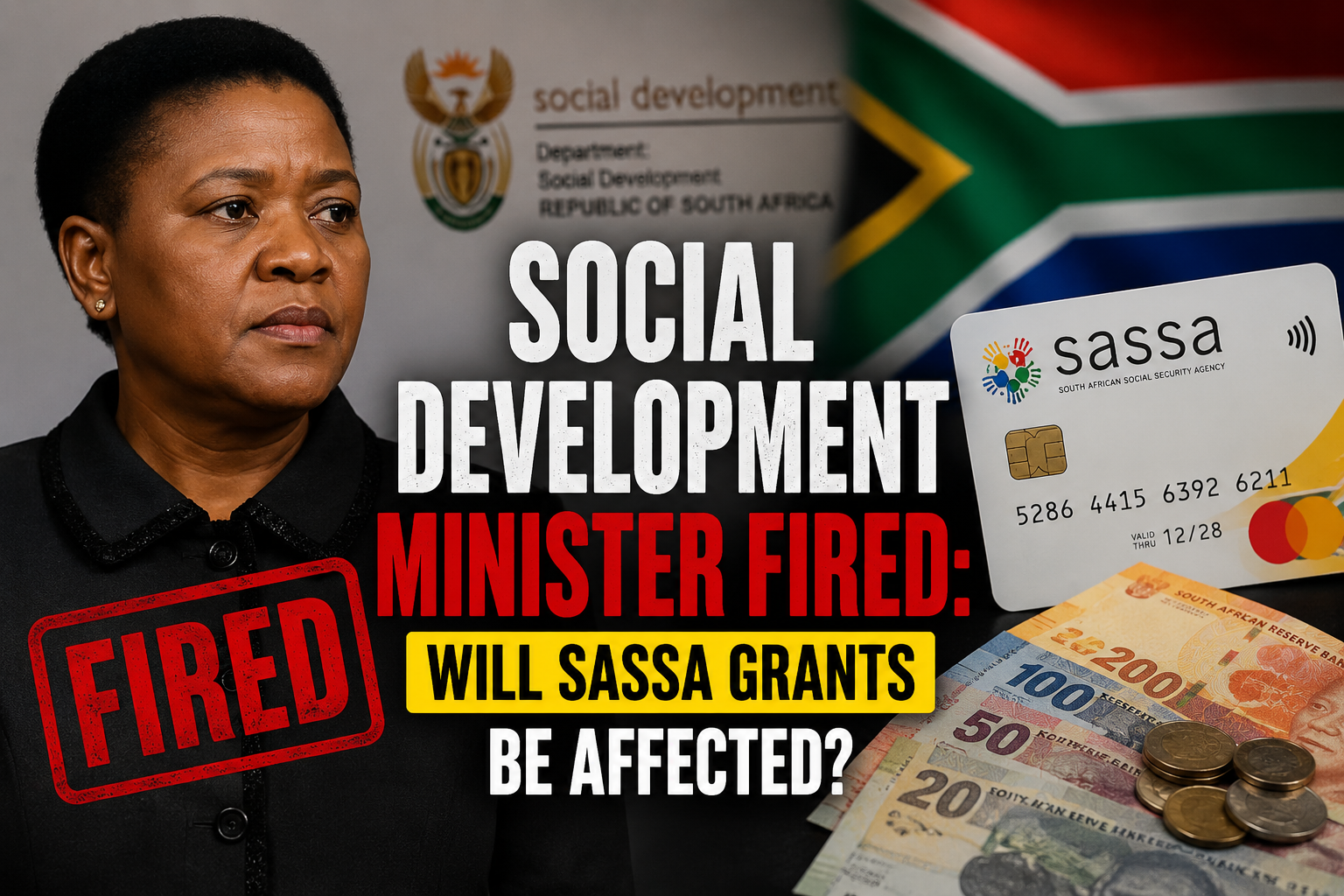
The news broke on a Thursday afternoon and within hours, SASSA community groups across the country were asking the same question: what happens to my grant now?
Thank you for reading this post, don't forget to subscribe!On 14 May 2026, President Cyril Ramaphosa dismissed Social Development Minister Sisisi Tolashe following months of public scandal. For the millions of South Africans who depend on a SASSA grant every month, the immediate concern was not political. It was personal. Will my payment still come through? Will my application still be processed? Is SASSA itself in trouble?
This guide answers those questions directly, separates the political story from the operational reality, and tells you exactly what has and has not changed for beneficiaries.
What Actually Happened
President Cyril Ramaphosa officially removed Sisisi Tolashe as Minister of Social Development on 14 May 2026, exercising his constitutional authority under Section 91(2), which allows the president to appoint and dismiss Cabinet ministers.
The dismissal followed months of mounting public pressure. Presidential spokesperson Vincent Magwenya confirmed the decision to SABC News, stating that due to a number of issues that had been widely discussed publicly, the President felt it best to remove the minister.
Sindisiwe Chikunga, the Minister in the Presidency for Women, Youth and Persons with Disabilities, was appointed as acting Minister of Social Development while government searches for a permanent replacement.
The Department of Social Development is the government department responsible for the South African Social Security Agency, which administers grants to millions of beneficiaries across the country. This is why the news immediately raised concern among grant recipients, even though the operational running of SASSA itself sits separately from the minister’s office.
Why Was the Minister Fired?
The dismissal followed a lengthy string of public controversies that built up over nearly two years. Understanding the broader context helps explain why this became politically unsustainable, even though none of it directly involves the day-to-day payment of grants.
The most prominent controversy centred on two luxury SUVs. Reports indicated that the minister had accepted two donated vehicles in late 2023, intended for the ANC Women’s League, and failed to disclose this to Parliament. The vehicles were later registered in the names of her children, and one was reportedly sold. This prompted opposition parties to lay criminal charges relating to fraud and misleading Parliament.
Additional controversies included an irregular senior appointment of a 22-year-old as acting chief of staff, a position later found by the Public Service Commission to have involved a falsified curriculum vitae, and reports concerning the misuse of a government-funded support worker who was instead deployed as private domestic help at the minister’s residence.
The Democratic Alliance and Action SA had been calling for her removal for weeks before the dismissal, including a formal letter from DA leader Geordin Hill-Lewis sent to the President in late April 2026.
The ANC’s own internal disciplinary processes have continued independently of the Cabinet dismissal. The party’s National Executive Committee subsequently referred the former minister, along with several other senior members, to its National Disciplinary Committee for bringing the party into disrepute.
Does This Affect SASSA Grant Payments?
This is the most important question, and the answer is reassuring.
For SRD beneficiaries concerned about whether the ministerial change affects grant payments, the SASSA payment cycle continues as scheduled. The administration of the R370 grant remains governed by the same rules and the same SRD grant means test that applied before the Cabinet change.
There are several reasons why a change at the ministerial level does not disrupt day-to-day grant administration.
SASSA operates as an independent government agency under the Department of Social Development, but its operational functions, including payment processing, banking integrations, eligibility verification, and the call centre, are run by SASSA’s own management structure, not by the minister personally. The minister sets policy direction and is accountable to Parliament, but does not personally process payments or manage individual beneficiary accounts.
The payment schedule for any given month is approved by National Treasury months in advance, not decided by the minister on a discretionary basis. The June 2026 payment schedule, for example, was already confirmed and locked in before this leadership change took place.
SASSA’s own leadership, including CEO Themba Matlou, continues to manage the agency’s operations. The agency’s anti-fraud programmes, eLife certification requirements, and biometric verification rollout were already underway before the dismissal and continue unaffected.
For SRD beneficiaries specifically, you can check your current SRD status at any time to confirm your application or payment is being processed normally. Nothing about the ministerial change alters how that status check works or what the results mean.
What Acting Minister Chikunga Inherits
Sindisiwe Chikunga steps into the role at a genuinely demanding moment for the department. Acting Minister Chikunga inherits a portfolio under pressure on multiple fronts, including SRD reauthorisation discussions and ongoing debate around a potential Basic Income Grant.
Beyond the political fallout from her predecessor, the acting minister also oversees a department in the midst of a significant operational transformation. SASSA’s anti-fraud and verification drive has already reduced the overall beneficiary count from approximately 19.3 million at the start of the 2025/26 financial year to roughly 18.8 million in March 2026, a decline of nearly 500,000, generating savings the agency estimates at around R44 million per month.
The acting minister also inherits unresolved questions about the long-term future of the SRD grant, which has operated as a temporary measure since its introduction during the Covid-19 pandemic and has been extended multiple times since.
Beneficiaries waiting on appeals can still follow the SASSA appeal process through the Independent Tribunal for Social Assistance Appeals, which operates independently of the minister’s office. If your SRD application was declined and you want to challenge that decision, the complete step-by-step SRD appeal guide walks you through exactly how the process works regardless of who holds the ministerial position.
Her appointment is explicitly temporary, pending the naming of a permanent replacement. The impermanence of an acting appointment does not typically translate into operational instability at SASSA itself, since the agency’s day-to-day functions continue under its own management structure throughout any ministerial transition.
What This Means for Ongoing SASSA Priorities
Several major initiatives were already in motion before this leadership change and continue regardless of who holds the ministerial portfolio.
The Postbank Gold Card deadline remains unchanged. Beneficiaries still using the older SASSA Gold Card must switch to the new Postbank Black Card before 31 August 2026. This deadline was set by Postbank and National Treasury, not by the minister’s office, and is unaffected by the Cabinet change.
eLife certification requirements continue. SASSA continues to require annual life certification to confirm that beneficiaries remain eligible and contactable. This administrative requirement is not tied to the minister and continues under the acting minister’s oversight.
Grant amounts for 2026/27 remain as confirmed. The grant increases approved by National Treasury in the February 2026 Budget, including the increase of permanent grants by R80 and the Child Support Grant to R580, were locked in before the ministerial change and are not affected by it. For the complete breakdown of current grant amounts, see the full SRD R370 grant details and eligibility guide.
The anti-fraud and verification crackdown continues. SASSA’s intensified income, banking, and identity cross-checks against SARS, UIF, NSFAS, and Home Affairs records were already in motion as part of a broader Treasury-driven cost-saving initiative and will continue under the new acting minister.
Should You Be Worried About Your Grant?
Based on everything confirmed so far, there is no indication that your individual grant payment, application, or status is affected by this leadership change.
The political turmoil surrounding the former minister relates to her personal conduct and departmental governance issues, not to the mechanics of how SASSA processes and pays grants. The agency’s payment infrastructure, banking partnerships, and verification systems operate independently of who occupies the ministerial office at any given time.
That said, it is reasonable to stay alert to a few things in the coming months. A new permanent minister, once appointed, may set new policy priorities that could eventually affect longer-term decisions such as the future structure of the SRD grant or progress on the proposed Basic Income Grant. These are policy-level discussions that play out over months, not immediate operational changes to your monthly payment.
If you want to stay informed about your specific payment situation rather than general political developments, the most useful thing you can do is regularly check your own status. For SRD beneficiaries, the complete guide to every SASSA SRD status meaning explains exactly what each result on your status page means and what action, if any, you need to take.
A Pattern of Leadership Turnover at the Department
This is not the first leadership disruption the Department of Social Development has experienced in recent years, and it is worth understanding the broader pattern.
The former minister was appointed in July 2024, replacing Lindiwe Zulu following a post-election Cabinet reshuffle under the Government of National Unity. Her removal less than two years later means the department has now seen multiple changes in leadership within a relatively short period.
Frequent ministerial turnover at the political level has not historically translated into instability at SASSA’s operational level. The agency’s core functions, including payment processing, application reviews, and call centre support, are run by permanent SASSA staff and management who remain in place through political transitions. Beneficiaries who have lived through previous ministerial changes will recognise that their day-to-day experience with SASSA, including payment dates, application processing times, and verification requirements, typically continues without interruption.
Frequently Asked Questions
Will my SASSA grant payment be delayed because the minister was fired?
No. SASSA’s payment cycle continues as scheduled. The administration and rules governing your grant remain unchanged following the ministerial dismissal. Payment dates are set by National Treasury well in advance and are not controlled by the minister directly.
Who is in charge of SASSA now? Sindisiwe Chikunga has been appointed acting Minister of Social Development, overseeing the department responsible for SASSA, pending a permanent appointment. SASSA’s day-to-day operations continue to be run by its own management team, led by CEO Themba Matlou.
Will this affect my SRD appeal or pending application?
No. The Independent Tribunal for Social Assistance Appeals operates independently of the minister’s office and continues processing appeals under the same rules and timelines as before.
Does the leadership change affect the SRD grant’s future beyond 2027?
The long-term future of the SRD grant, including potential conversion into a permanent Basic Income Grant, remains an open policy discussion. This is a longer-term matter that the new permanent minister, once appointed, will likely weigh in on, but it does not affect your current monthly payment.
Has SASSA’s anti-fraud crackdown stopped because of this change?
No. The verification and eligibility review programme, including biometric enrolment and eLife certification requirements, continues unaffected. These initiatives are driven by Treasury cost-saving mandates rather than ministerial discretion.
Is the former minister facing any further consequences?
Yes. Beyond the Cabinet dismissal, the ANC’s National Executive Committee referred her to the party’s National Disciplinary Committee, and criminal cases relating to alleged fraud and misleading Parliament remain open with the police, separate from her removal from Cabinet.
The Bottom Line
The dismissal of the Social Development Minister is a significant political story, but it is not a SASSA payment story. Your grant, your application, your appeal, and your verification status are all governed by systems, rules, and schedules that operate independently of who holds the ministerial office.
If you are genuinely concerned about your specific payment, the most useful action is checking your own status directly rather than following the political news cycle. For SRD beneficiaries, check your current status here to confirm everything is processing normally on your file.
The bigger questions, the long-term future of SRD, the possibility of a Basic Income Grant, and who will be named as the permanent minister, will play out over the coming months. None of them change what lands in your account this month.
Have questions about how this news affects your specific grant situation? Leave them in the comments below, and we will keep this page updated as developments unfold.
This article reflects information available as of June 2026. Cabinet appointments, parliamentary processes, and criminal proceedings may develop further. For the most current information on your grant specifically, visit www.sassa.gov.za or call the toll-free helpline on 0800 60 10 11.