
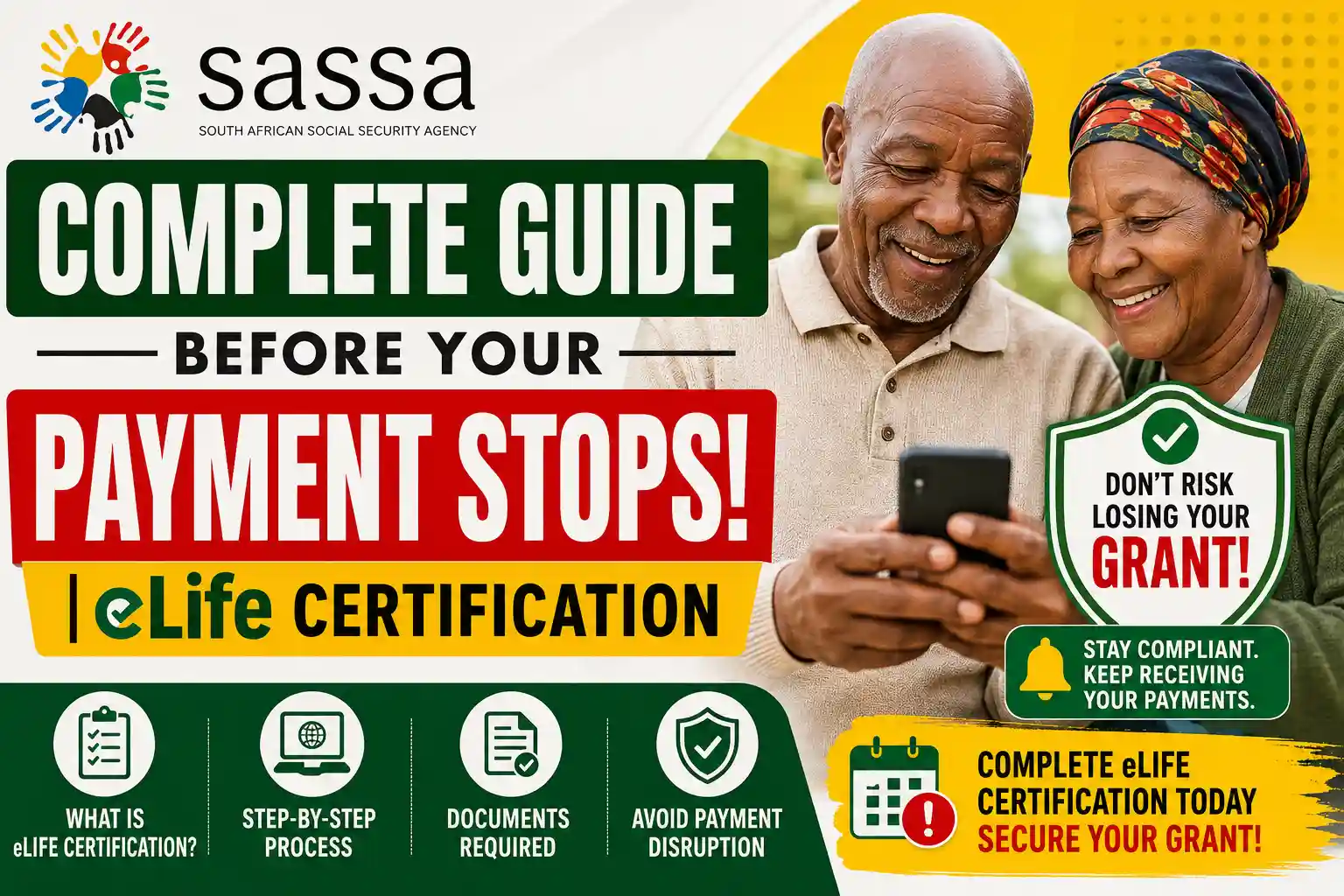
Meta title: SASSA e-Life Certification 2026: Complete Guide & Portal Steps (59 chars) Meta description: SASSA e-Life Certification explained. Who must complete it, how to do it online at services.sassa.gov.za, and what happens if you miss the deadline. (148 chars)
Thank you for reading this post, don't forget to subscribe!URL slug: /sassa-elife-certification-2026/
Last Tuesday, a grandmother in Mpumalanga called her daughter in tears. She had received an SMS from SASSA saying she needed to complete something called “e-Life Certification” within days, or her Older Persons Grant payment on 5 May 2026 would stop. She did not know what e-Life was. She did not know the portal. She did not own a smartphone with a proper camera. She was terrified her R2,400 would not arrive next month.
She is not alone. Over the past two weeks, SASSA has issued urgent advisories to more than 18 million beneficiaries across South Africa about the same thing: complete your e-Life Certification before your next payment date, or risk grant suspension.
The problem is that very few beneficiaries actually understand what e-Life Certification is, who it applies to, how to complete it online, or what happens if the system fails halfway through. The official SASSA communication is brief. The news articles are scattered. And scammers are taking advantage of the confusion by sending fake e-Life verification messages asking for bank PINs and personal details.
This guide fixes all of that. By the end, you will know exactly whether you need to complete e-Life Certification, how to do it step-by-step using the official portal at services.sassa.gov.za, what errors to expect, and how to spot scams pretending to be SASSA. Everything here is verified against SASSA’s official announcements from April 2026.
What Is SASSA e-Life Certification?
SASSA e-Life Certification is a digital verification process that confirms you are still alive and still eligible to receive your social grant. It is a legal requirement under the Social Assistance Act and has existed for years in physical form. In 2026, SASSA has moved it fully online, which means most beneficiaries can now complete the process from home using a smartphone, tablet, or computer with a camera.
The process uses biometric verification through SASSA’s electronic Know Your Client system, also called eKYC. When you log in to the SASSA online services portal, the system takes a live photo or scan of your face and matches it against records held by the Department of Home Affairs. If the match is successful, your grant remains active. If the verification fails or you ignore the request, SASSA may interpret your account as deceased or no longer legitimate, and your grant payments will be suspended.
Before 2026, beneficiaries had to physically visit a SASSA office every year to prove they were alive. This meant long queues, travel costs, and time off work for family members who helped elderly relatives. The new digital system aims to eliminate that entirely. SASSA has acknowledged that the rollout has faced technical issues, but confirmed on 21 April 2026 that the portal is now functioning correctly after system fixes.
Who Must Complete e-Life Certification in 2026?
This is where most beneficiaries get confused, and where scammers exploit the uncertainty. Here is the honest truth: not every beneficiary needs to complete e-Life Certification immediately.
SASSA operates two tracks for e-Life Certification. The first is annual encouragement, which applies to all beneficiaries across all grant types. SASSA has asked everyone to complete the process once per year as a general policy. The second track is targeted immediate certification, where SASSA specifically flags certain beneficiaries who must comply within a stated timeframe regardless of age or grant type.
If you have received an official SMS, WhatsApp message, or email from SASSA asking you to complete e-Life Certification within a specific deadline, you are on the targeted track and must act immediately. If you have not received any official request, you should still plan to complete it during 2026 but you are not under emergency deadline pressure.
The beneficiaries most likely to be flagged for immediate certification include:
- Older Persons Grant recipients (60+ years old) who have not verified recently
- Disability Grant beneficiaries with older case files due for renewal
- Child Support Grant primary caregivers whose records need updating
- Foster Care Grant holders requiring court order confirmation
- Beneficiaries with flagged banking details or suspected duplicate profiles
- Anyone whose Home Affairs record has been updated recently
SRD R370 beneficiaries do not typically face the same e-Life requirement, since the SRD grant already runs monthly eligibility checks automatically. If you receive only the SRD grant and have not been contacted, you likely do not need to take action right now. For the most current status of your SRD application, use our SASSA status check guide.
How e-Life Certification Works: The Portal Process
The entire process takes between 5 and 15 minutes if everything works smoothly. Yes, that is a big “if”technical issues are still common, which we will cover later. But for beneficiaries with a stable internet connection and a device with a working camera, the steps are straightforward.
Here is exactly what happens:
- Access the portal. Go to services.sassa.gov.za in any web browser. This is the official SASSA Online Services Portal. Some SASSA communications also reference ssreforms.sassa.gov.za as a backup URL. Both lead to the same verification system.
- Register or log in. First-time users must create an account using their 13-digit South African ID number, registered cellphone number, and a valid email address. Returning users simply log in with existing credentials.
- Locate e-Life Certification. Once logged in, find the e-Life Certification option on your dashboard. It is usually prominently displayed if you have been flagged for certification.
- Start biometric verification. The system will prompt you to allow camera access. You will need to position your face clearly in good lighting and follow on-screen instructions for a live facial scan.
- Wait for the Home Affairs match. Your biometric data is compared against Department of Home Affairs records. This takes anywhere from a few seconds to several minutes depending on system load.
- Confirm your details. Review the personal information SASSA has on file. Update anything that has changed, such as your phone number, address, or banking details.
- Submit and save confirmation. Once everything matches, your certification is recorded and timestamped in the system. Screenshot or download your confirmation as proof.
The portal works on any device with internet access and a camera, including smartphones, tablets, and laptops. SASSA officially recommends using a smartphone with a good camera for best results.
What to Do If the Portal Is Not Working
Let me be brutally honest here. The SASSA e-Life Certification portal has had real technical problems throughout 2026. In April, SASSA officially apologised for system glitches linked to interfaces with other government departments. The agency confirmed on 21 April 2026 that the issues have been resolved, but user reports continue to show intermittent failures.
Common problems beneficiaries have reported include:
- The profile picture verification component not loading
- Facial scan failing repeatedly even with good lighting
- Home Affairs interface returning errors because no digital photo exists on file
- Verification SMS or email timing out before it can be entered
- Being logged out mid-process and losing all progress
- The portal only working on one device (switching phones breaks the session)
If you hit a problem, do not panic and do not submit the same form repeatedly. Duplicate submissions create additional system confusion and can delay your certification further. Instead, try these fixes in order:
- Close the browser completely and restart. Clear cache and cookies before trying again.
- Switch networks. If you are on mobile data, try Wi-Fi. If you are on Wi-Fi, try mobile data. Network latency can break the biometric handshake.
- Use a different device. If your smartphone camera keeps failing, try a laptop with a webcam.
- Try at a different time of day. Early morning (between 6am and 8am) typically has the fastest portal response times.
- Take the certification at a SASSA office instead. If the digital process fails repeatedly, you can still complete it in person at any SASSA branch. This is always available as a fallback.
If you live in a rural area without reliable internet access, or if your smartphone does not have a camera good enough for biometric scanning, visiting a SASSA office in person remains the most dependable option. Bring your original South African ID and any SMS or messages you have received from SASSA.
What Happens If You Miss the Deadline?
This is the question keeping beneficiaries awake at night, and the answer matters because it varies depending on whether you were specifically flagged or simply encouraged.
If SASSA specifically contacted you with a deadline and you fail to comply within that timeframe, your grant payments will be delayed or temporarily suspended. The agency has stated it may interpret non-compliance as a signal that the beneficiary is no longer alive or no longer legitimate. Suspension is not permanent. Once you complete the verification, your grant is restored and typically resumes within the next payment cycle, though backpay for missed months is not guaranteed in all cases.
If SASSA has not specifically contacted you but you have not yet completed your annual certification, there is no immediate suspension. You should still aim to complete the process during 2026 to avoid future issues, but no payment is being blocked right now.
The critical distinction is this: official SASSA messages will always reference a specific deadline and come through verified channels. They will never ask for your banking PIN, password, OTP, or any form of payment. If the message creates urgency without specifics or asks for sensitive information, it is a scam.
To check whether you have been officially flagged, log into the SASSA portal directly at services.sassa.gov.za or call the toll-free helpline at 0800 60 10 11. Never rely on WhatsApp messages or SMS links from unknown numbers to confirm your status.
How to Spot e-Life Certification Scams
The rollout of e-Life Certification has created a perfect opportunity for fraudsters. Over the past month, multiple fake messages have been circulating on WhatsApp and SMS claiming to be from SASSA. Here are the red flags to watch for.
Scam message patterns:
- “Your SASSA grant will be cancelled in 24 hours unless you verify now. Click here.”
- “SASSA e-Life verification fee R50 required to activate certification.”
- “Send your banking details to complete e-Life process.”
- “Forward this message to 10 contacts or your grant will stop.”
- “Dial *XXX# and enter your OTP to verify.”
SASSA communicates through verified official channels only: the services.sassa.gov.za portal, the official WhatsApp number 082 046 8553, the toll-free helpline 0800 60 10 11, and direct SMS from known SASSA shortcodes.
What SASSA will NEVER do during e-Life Certification:
- Ask for any payment, deposit, or “activation fee”
- Request your banking PIN, password, or OTP
- Demand you verify through unofficial websites or third-party apps
- Threaten immediate grant cancellation without giving a specific deadline
- Ask you to forward messages to other people
If you receive anything that matches these scam patterns, do not click any links. Report the message to SASSA by calling 0800 60 10 11 or emailing grantenquiries@sassa.gov.za. For ongoing protection, see our detailed explanation of common SASSA status check scams and how to avoid them on the main status check guide.
Who Gets Priority: Understanding the Flagging System
Not all beneficiaries are treated equally in the 2026 e-Life rollout. SASSA uses an internal risk-scoring system to decide which accounts need immediate verification versus which can wait for annual certification.
High-priority flags (immediate certification required):
- Accounts over five years without any in-person verification
- Beneficiaries whose banking details were recently changed
- Profiles with mismatched information between SASSA and Home Affairs
- Applicants whose ID numbers triggered fraud detection systems
- Elderly beneficiaries where family members are collecting on their behalf
- Cases flagged after reports of suspicious activity
Standard flags (annual certification during 2026):
- Older Persons Grant beneficiaries over 60
- Disability Grant recipients with active medical assessments
- Child Support Grant primary caregivers
- Foster Care Grant court-ordered placements
- Grant-in-Aid recipients requiring regular review
Lower priority (no immediate action required):
- New beneficiaries who applied within the past 12 months
- SRD R370 grant recipients (monthly eligibility already verified automatically)
- Beneficiaries who completed e-Life verification within the past 12 months
If you are unsure which category you fall into, the fastest way to check is logging into services.sassa.gov.za. If certification is required, it will be prominently displayed on your dashboard with a deadline.
e-Life Certification vs Other SASSA Status Checks
Beneficiaries often confuse e-Life Certification with other SASSA verification processes. Here is a quick breakdown of the differences.
| Process | Purpose | Frequency | Where |
| e-Life Certification | Confirm you are alive and eligible | Annually | services.sassa.gov.za |
| SASSA Status Check | Check grant application or payment status | Monthly | srd.sassa.gov.za |
| SRD Appeal | Dispute a declined application | Within 90 days of decline | srd.sassa.gov.za |
| Banking Details Update | Change payment account | When needed | srd.sassa.gov.za |
Each process serves a different purpose. Completing e-Life Certification does not change your monthly status, and checking your monthly status does not satisfy the e-Life requirement. If you receive both an e-Life request and see a pending status, complete e-Life first, then check status.
What to Do Before Your May 2026 Payment
With confirmed May 2026 payment dates approaching, here is exactly what every beneficiary should do in the next week to avoid payment disruption.
If you have received an official e-Life request:
- Complete it online at services.sassa.gov.za immediately
- If the portal fails, visit your nearest SASSA office with your ID
- Keep a screenshot of your confirmation
If you have not received any request but want to be safe:
- Log into services.sassa.gov.za and check your dashboard
- If no e-Life notification appears, no immediate action required
- Plan to complete annual certification later in 2026
If you only receive the SRD R370 grant:
- Your monthly SRD status check handles most verification automatically
- e-Life typically does not apply unless specifically requested
- For May 2026 SRD payments, batches run between 21 and 31 May
If you cannot access the portal at all:
- Call the helpline at 0800 60 10 11
- Visit a SASSA office in person with original ID
- Ask family members with internet access to help where possible
For detailed information on May 2026 payment schedules across all grant types, see our complete payment dates guide.
Frequently Asked Questions
Do all SASSA beneficiaries need to complete e-Life Certification in 2026?
Not immediately. Everyone is encouraged to complete it annually, but only beneficiaries specifically flagged by SASSA must comply within a stated deadline. If you have not received an official SMS, email, or WhatsApp from SASSA with a specific deadline, you are on the general annual track and not under emergency pressure.
Is there any fee for e-Life Certification?
No. The process is completely free through the official SASSA portal at services.sassa.gov.za. If anyone asks you to pay any amount, it is a scam. SASSA never charges for verification.
How do I know if the SASSA message is real or a scam?
Real SASSA messages come from verified shortcodes and reference a specific deadline. They never ask for banking PINs, passwords, OTPs, or payment. If the message has suspicious links or creates panic without specifics, it is fraudulent. Verify through services.sassa.gov.za or call 0800 60 10 11 before taking action.
What if I fail the biometric facial scan?
Try again in good lighting with a clean camera lens. If it keeps failing, the issue may be on SASSA’s side (missing Home Affairs photo, database mismatch). Visit a SASSA office in person with your original ID for manual verification.
Can someone else complete e-Life Certification for me?
No. Biometric verification requires your live facial scan. Only the beneficiary can complete the process. Family members can assist by operating the device and guiding the elderly or disabled through the steps, but the face in the camera must be the beneficiary’s own.
Will my grant be permanently cancelled if I miss the deadline?
No. Missed deadlines result in temporary suspension, not permanent cancellation. Once you complete verification, your grant is typically restored in the next payment cycle. However, backpay for missed months is not always guaranteed.
What do I do if the portal keeps crashing?
First, try switching networks, devices, or times of day. Morning hours typically have better system response. If the portal continues to fail after multiple attempts, visit any SASSA office in person. Digital failure is not an acceptable reason for non-compliance.
Does completing e-Life affect my monthly SRD status?
No. e-Life Certification and monthly SRD status check are separate processes. Completing one does not satisfy the other. If you have both requirements, complete each independently.
How long does the certification last?
Certification is valid for 12 months. You will need to repeat the process annually unless SASSA specifically requests earlier re-verification due to flagged account activity.
Can I complete e-Life Certification at a SASSA office?
Yes. If you cannot access the digital portal, any SASSA office can process your certification in person. Bring your original South African ID document and any SMS or messages SASSA has sent you about the requirement.
The Bottom Line
SASSA e-Life Certification is not something to panic about, but it is something to take seriously. If you have been officially contacted by SASSA with a deadline, complete the process immediately through services.sassa.gov.za or at your nearest SASSA office. If you have not received any specific request, plan to complete it at some point during 2026 but do not let scammers rush you into fake verification flows.
The grandmother from Mpumalanga I mentioned at the start completed her certification at her local SASSA office last week, after trying the portal three times without success. Her May 2026 Older Persons Grant is now secure. She told her daughter afterwards that the hardest part was not the verification itself, but the week of fear before she understood what it actually required.
That fear is what this guide is meant to remove. The process is real, the deadlines are real, and the risk of suspension is real. But with the right information and the right steps, every beneficiary can complete e-Life Certification confidently without falling for scams or losing sleep over technical errors.
Bookmark this page. Share it with anyone who receives a SASSA e-Life message. And if you need help with related issues, use our guides on SASSA status checks, understanding status results, appealing declined applications, or changing your registered phone number.
Your grant is your lifeline. A few minutes to complete e-Life Certification correctly protects it for another year.